


Lookout post and dike corner
Dishoek arose at the end of the 13th century by the highest dunes in Zeeland, long an important landmark from the sea.
- Lookout for Vlissingen: like the vanished De Vijgheter, Dishoek was founded as a lookout post for the port and fortified town of Vlissingen.
- A dike in the dunes (1293): around 1293 a sea dike was built to reinforce a weak stretch of dunes; the village owes its name to this Dyckshoecke, or dike corner.
- Remains on the beach: after a storm surge, when much sand has been washed away, remains of the old dike can still be seen.
- Iconoclasm (1566): according to tradition, the first iconoclastic outbreak in the northern Netherlands took place in the dunes near Dishoek in 1566.
- Guard houses (1579): from 1579 guard houses were built to protect Walcheren, making the area safer so that people settled near the posts.

Lighthouses, bunkers and the war
For centuries the dunes at Dishoek mattered for shipping and for defending the mouth of the Scheldt.
- Yellow and red: the two square brick towers are striped yellow and red and have no lantern; the light shines through a window at the top.
- Rubble and rebuilding: after the war little was left of Dishoek but rubble and badly damaged buildings, yet reconstruction got under way quickly.
- Walcheren flooded (1944): in 1944 Walcheren was flooded for the liberation; for months the tides swept freely across the island.


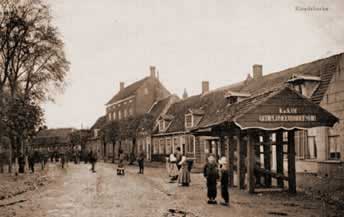
Koudekerke, the mother village
Dishoek began as a hamlet of Koudekerke and is still officially counted as part of it.
- A church ring village (1067): Koudekerke was founded around 1067 on a creek ridge near three refuge mounds; around the church grew the large village square of this church ring village.
- Country estates: stately country houses arose around the village, of which Der Boede, Ter Hooge, Moesbosch and Toornvliet still exist.
- A large municipality: the municipality of Koudekerke, which existed from 1811 to 1966, once reached the canals of Middelburg; in 1941 part of it was added to Middelburg.
- Spared by the water: the 1944 flooding erased many old field boundaries, but the village ring was spared and became the core of post-war expansion.
- Valkenisse and Veere: in 1966 Koudekerke became part of the municipality of Valkenisse, which joined the municipality of Veere in 1997.

Tourism on the Zeeland Riviera
After the First World War Dishoek slowly developed into a popular recreation area.
- De Vroonslag (1920): in 1920 the cycle path De Vroonslag was laid, and people began selling sweets and minding the bicycles of beachgoers.
- The first beach pavilion (1929): in 1929 the first sales point opened on the beach, which later became the Piet Hein beach pavilion.
- Pension Westduinen (1930): in 1930 the first guesthouse was built, which grew into today's Strandhotel Westduin.
- Holidays in the woods (1949): in 1949 one of the first holiday parks in Zeeland was built in the Vebenabos.
- The Zeeland Riviera: together with Zoutelande and Westkapelle, this coast is called the Zeeland Riviera, because few Dutch resorts have a south facing beach.


